
Podcast: Play in new window | Download
You wake up exhausted. You go to bed guilty. And somewhere in between, you’re running on empty while everyone else gets the best of you. If you’re searching for how to handle homeschool overwhelm, you’ve landed in the right place—because what you’re feeling is real, and it’s more common than you think.
You’re not failing. You’re just carrying too much.
The overwhelm you’re feeling isn’t about curriculum choices or behaviour issues. It’s deeper than that. You’re juggling lesson plans, emotional meltdowns, household chaos, and a never-ending mental load—all while wondering if you’re doing enough. You feel like you’re losing yourself and you can’t remember the last time you felt truly present or at peace.
You shouldn’t have to sacrifice your well-being to give your children a great education. Homeschooling was supposed to bring freedom—not steal it.
But here’s what most homeschool moms don’t realize: You can’t fix what you can’t see.
Hi, I’m Teresa—and I’ve been exactly where you are.
After years of homeschooling my own kids, I buried my struggles, ignored my needs, and kept pushing through. Until I couldn’t anymore.
That’s when I discovered the truth: the overwhelm wasn’t about doing more—it was about understanding what I actually needed.
Now, as a Certified Life Coach, I’ve helped hundreds of homeschool moms identify the hidden roots of their stress and reclaim their peace, purpose, and presence.
From one homeschool mama to another—I know you can do this, because I’ve done this.
Not Sure Where Your Overwhelm Is Coming From? Start Here.
I created a free 5-minute quiz to help you find out.
It covers 8 key areas of your life—emotional load, self-identity, energy, relationships, mental clarity, boundaries, purpose, and joy—and gives you personalized results that show you exactly which areas are thriving and which are quietly draining you.
Not generic advice. Just clarity.

Here are 15 tips on how to handle homeschool overwhelm…
1. We must instill and maintain boundaries.
What does the word “boundaries” mean to you?
We all create different definitions of words and this one is loaded with different ideas.
You might have boundaries issues in your homeschool if you spend too much time thinking about…
- what do other people think about your homeschool
- knowing that you want more time for you but not getting it
- answering the phone when you should be eyeball-to-eyeball with your kids
- recognizing that you need more time spent on developing you but are not sure how or where you can do that
- spending more time doing extracurriculars because people are asking you to participate, even though you want a quiet day at home
- giving your time away to meaningful things, but not the most important things
- fielding unsupportive questions about your homeschool choice
- feeling exhausted by conflict with your partner
- knowing you’re not showing up as you’d like with your kids but you’re not sure why
- feeling guilty or ashamed at how you’re showing up with your kids
- desperately wanting a separate space or time away from your kids
- feeling your kids are mistreating you or disrespecting you, but you can’t quite figure out if that is just them being kids
- you feel unsupported and you don’t think you can ask even the most important people in your life to help
Straight up, if you identify with these thoughts, you need stronger boundaries.
I’ve come to understand that the energy we have for our homeschools (& lives) is directly proportional to our established boundaries:
- the boundaries we have in our relationships,
- whether that be our relationship to others or ourselves,
- and also how we’re framing the vision of our homeschool.
You can do some of these things to help establish boundaries:
- Schedule just 15 minutes a week outside the home just for you.
- Schedule a quiet afternoon break with the kids as part of your regular routine. (& expect the kids to play quietly in their rooms, or allow them to use screens at that time, but every afternoon, schedule a collective time.)
- Put your screens away between your formal homeschool hours (or at least, turn off notifications).
- Tell family and friends you’re not available between certain hours, so you can focus on the kids.
- Preplan responses to commonly asked homeschool questions by the public or family members.
Also consider doing these things:
- Determine how you’re going to address your emotional triggers in your homeschool.
- Think about how much time you want to invest in playdates and extracurriculars before the year begins.
- Determine how much time you want to invest in playdates and extracurriculars before the homeschool year begins, so you actually spend time at home.
- Time block your week determines how much time every activity is taking you and decides which ones can be deleted.
- Request your needs be met by the important relationships in your life. (And if this is especially challenging for you, talk to a coach or counselor to address this challenge).
- Intentionally create a homeschool community. (You are always welcome to join the Confident Homeschool Mom Collective where we homeschool mamas show up on purpose in our homeschools & lives and support one another).

2. We need to take activities off the list if we want to know how to handle homeschool overwhelm.
Most of our homeschool lives are too big.
We have…
- Too many activities planned for the kids.
- Too many playdates so we don’t have to question ourselves alongside random strangers, “what about socialization?”
- Too many places to explore (field trips!)
And they’re all great ideas, of course.
But too many activities are just too many.
And too many=overwhelm. Which is not a happy-making place to be!
To prevent this?
Time block your week.
How much time does every activity actually take?
Write every activity down.
(Yes, every activity. And yes, this is a lot of work. But you only need to do this once to gain clarity.)
Like every activity…
- dishwashing
- floor sweeping
- dressing kids in the morning
- the time it takes to drive to soccer practice
- how much time you spend on the phone chatting with a friend
- how much time you’re on Instagram
- when you sit with the kids to do a readaloud
- when you drive to spend time with a friend at a nature reserve
- when you show your kids how to sound out a word
- how much time you spend on Netflix
- how much time you chat with your partner
All.the.things.
As Tolstoy so famously declared, “Our whole life is taken up with anxiety, with preparations for living, so that we really never live at all.”
We have an opportunity to really live, to harness the freedoms that homeschool enables, so let’s choose our activities on purpose.
3. Learning to Exist Together Is Essential When You Want to Handle Homeschool Overwhelm
One of the most underrated strategies for handling homeschool overwhelm is getting intentional about how you exist alongside your kids every single day. We homeschool mamas intuitively know this — but knowing and doing are very different things. Too often we reactively engage throughout our days instead of responding thoughtfully to triggers and big emotions as they come up.
Here’s the truth about homeschool family harmony: it’s never going to be perfect. We’re human. We’re all learning from each other — kids and adults alike. Your children are practicing interpersonal skills, sometimes effectively and sometimes not. So are you. That’s not failure — that’s growth.
What actually helps is getting honest about two things:
- What your core values are
- How you actually want to show up with the people who matter most to you
When you know those two things, you can start responding on purpose instead of reacting out of exhaustion.
Getting honest about how you’re actually showing up — versus how you want to show up — is exactly what we uncover together in a free Aligned Homeschool Reset session. One conversation can give you more clarity than months of pushing through alone. Book your free session here →
4. We need time alone if we want to learn how to handle homeschool overwhelm.
Quiet time for me is as necessary as breathing fresh air.
How to find quiet:
- Go for a run or a neighbourhood walk when the oldest can look after the youngest.
- Arrange a Saturday afternoon swap — send your kids to a friend’s house and trade kids once a week.
- Plan a getaway for when your partner arrives home, even if it’s just an hour out alone.
- If both parents are home together, one parent might take responsibility for the morning and another parent takes responsibility for afternoon activities.
- Get up before the kids. (Yes, I know this can be a challenge with younger kids, but just two mornings a week might profoundly benefit you.)
- Designate screen time for your quiet time.
- Designate a basket of special activities just for quiet time.
- Head to another room and place a timer outside the door so kids know when you’re available: when the alarm goes off.
- Leave the home. By yourself. Even an afternoon of errands alone can refresh you when you’re accustomed to being with kids all day.
- Being home alone is the sweetest quiet. (Also the trickiest quiet time to find.)
- Sit your kids with grandparents reading zoom dates. Grandparents can read stories or play trivia games or online games with kiddos while you’re in another room. And they’re in their Zoom Room.
- Have kids go to bed early once a week. Let them be on their bed with games or books for longer than typical bedtime.
- As a final option, get noise-cancellation earphones. Point to the earphones, which declare, “Mom is not available”. (And eventually, they’ll believe you when you practice this on repeat.)
Mama just has to know what she wants, be humble enough to ask, and set healthy boundaries, on repeat, until quiet time habits are entrenched in her routine.

5. Finding Your Own Thing Helps You Handle Homeschool Overwhelm: an all-about-homeschool mama thing
One day, you’re not going to be a homeschool mama.
Your last child will move away from your home, your kitchen counters will stay free of crumbs for more than twenty minutes, the laundry room will look like a room of respite and orderliness, and you will no longer be overseeing kids’ learning goals.
What will you do?
Nurture that YOU now.
Even in the small amount of time you have now, you can choose to do something that is just for you.
What do you like to do?
- Decoupage?
- Up your chess game?
- Garden?
- Plan events?
- Write novellas?
Invest just fifteen minutes a week doing the thing you love to do: just one thing just for you!

6. Communal Quiet Time Is an Underrated Strategy for Homeschool Overwhelm
**Don’t expect the kids to prefer this idea straight up but assume that over time, they will relish this time too.
After lunch is done, let the kids know that you’ll be enjoying a little quiet separately. They’ll be on each of their beds playing with a toy or looking at books. Or they’ll be watching a documentary in the playroom.
But you’ll be in your room, sitting in the corner chair with your iPad and Pinterest (& a box of cookies tucked under the cushion) for twenty minutes, or a half hour, or an hour, or two hours, whatever works for you.
This is a long-term strategy intended to reenergize you every day.

7. A Morning Routine Sets the Tone for Handling Homeschool Overwhelm
One of the most important things we can do is set our day with intentional energy and thoughts.
Create a morning routine for us, homeschool moms, to get kick-started before the kids are awake. Yeah, I know that is a real challenge if you have young kids. It might not even be realistic, but it is still the goal. So does that mean you have to get up at 4:00 am? No, I am not suggesting that. I would never have done that myself. My kids would laugh if I even suggested that to you.
Still, the goal is to be up before the kids are awake, especially the younger ones, so you can set your day with intention.
I start the day with a cup of coffee and milk. As I live in the northern hemisphere, I use a UV light in the morning for about 15 minutes. At the same time, I read my daily morning mama affirmations. This helps us set our minds thinking about the things we want in our homeschool and how we want to engage our children.
There’s no magic bullet in reading daily affirmations, but it does set our minds on the right things. Praying and meditating with intention and asking God for help strengthen my resolve and clarity.
Daily meditation practice and, of course, journaling.
I have been journaling since about Grade two. I didn’t have much to say then, so I wrote, I woke up, I made my bed, and I brushed my teeth for about the first five years. And though it was simple, it has been a powerful tool that helps me understand how I’m feeling and what I want to accomplish in my day.
Journaling is a powerful tool to start your morning.
I also write three focus words at the top of my journal. This year I wrote: encourage, expand, and invite. (And if you come over for a cup of coffee, I will tell you why I chose those words. They all relate to relationships, my work, or my intention for this period of my life.)
Choosing focus words sets our mind to approach our day and activities the way we want to.
First and foremost, set up your day with an intentional morning routine.

8. We need to get clear on what is overwhelming us.
So many reasons we might feel overwhelmed as a homeschool mom.
But since we’re all not the same humans having the same human experiences, we couldn’t possibly be experiencing overwhelm for the same reasons.
Use this Grappling with Overwhelm journaling workbook as a self-coaching tool to help address your needs, gain satisfying relationships, and shift your perspective.
Overwhelm is a feeling that can represent a lot of different issues around your needs, your relationships, and your perspective on your homeschool.
So get out your pen and dig deep into the following journaling questions to assess what issues you’re dealing with in your homeschool life.
These journal questions can aid in your self-exploration, so get curious about what you’re feeling, how you’re addressing your needs, how you understand your homeschool responsibilities, and how you engage in relationships.
If that video resonated with you, the next step is simple. The Aligned Homeschool Reset session is a free one-on-one conversation where we identify exactly what’s driving your overwhelm and what needs to shift. No homework, no pressure — just clarity. Book your free Aligned Homeschool Reset →
9. We need to sit with our feelings & accept our feelings despite their uncomfortableness.
What Are Your Feelings Trying to Tell You?
Anger, you can handle one kid being too sharp, but not four; you told that kid a thousand times to do something and they forgot again, or you’re simply feeling a lot of intense frustration around that premenstrual time of your month,
Irritation, sibling squabbles, constant interruptions of any thought you have, you can never find the scissors (or is that just me?), no matter how many times you clear the minivan of garbage, dog hair, it’s always gross,
Loneliness, wondering if you can have the kind of communal support that you need to have to do this homeschool thing for the long term.
Guilt, you lost it on your child, you don’t have the motivation to do the cool homeschool things everyone on Instagram or Pinterest is doing,
Stress, there’s more going on in your homeschool than homeschool, you’ve got a sick parent, you’re marriage is in a heck of a lot of trouble, you think you’re dealing with unresolved trauma or depression long before your family.
First, you have to know yourself: what even are your feelings?
You feel things all the time.
But you might not have built-in self-awareness practices to explain and understand your feelings.
Think about what typically triggers sadness for you. Anger — what sets it off? When do you feel genuinely glad? Consider what brings you happiness on an ordinary day. And confusion — what situations tend to leave you feeling lost or uncertain?
Acknowledging Your Big Emotions Is the First Step to Handling Homeschool Overwhelm
The first principle of wielding this tool is to acknowledge that you have big emotions.
Just as you can’t leave your tools or toolbox out in the rain, you can’t leave your big emotions out in the rain either. (AKA pretend they don’t exist).
Leave the electrical generator out in the rain, and when you most need it, it won’t be available, and you won’t be able to access electricity in a power outage. (This literally happened to us yesterday).
So the first thing we have to do? We have to acknowledge that we have big emotions and become familiar with them all, the comfortable emotions and the uncomfortable ones.
Here are a few practices you can practice to address your feelings:
If you want to get more familiar with your feelings, start with journaling.
How Journaling Helped Me Understand My Feelings as a Homeschool Mom
When I was seven, I purchased my first item ever, a green-locked journal.
In that journal, I wrote every morning:
- I woke up,
- I made my bed,
- And I brushed my teeth.
Not a lot of inspiring activities as a seven-year-old, but I wrote everything down.
And obviously, I didn’t have a lot of dental visits!
Over time, I learned to write and describe my feelings — the activities that preceded them, and how I responded to them. That practice grew into something bigger. Stories started spilling out: fiction rooted in my real life, snippets inspired by my favourite TV shows (everything with Michael J. Fox), short stories, novellas.
I just wrote a lot.
Writing became the way I processed my perception of the world around me. The page was where I worked through confusion and came out the other side with clarity.
This writing act helped me process my perception of the stories in the real world.
I wrote myself out of confusion.
And even in my coaching sessions today, I continue to encourage homeschool moms to journal in their notebooks about how they feel.
ps I’ve created a Journaling Notebook for Big Emotions for the Homeschool Mama so you can self-coach too.
10. We need to recognize the underlying needs of those feelings.
You have to take care of yourself if you’re taking care of homeschool kids
You are a human being in your homeschool that has needs too.
- Get to know your emotional atmosphere: sit with your uncomfortable feelings.
- Yoga or stretching practice.
- Exercise, every day.
- Include things that you like to learn in your homeschool too.
- Supplements & nutrition for your brain.
- Create quiet time just for you!
- Create a Homeschool Mom PMS Plan
- Challenge your uncomfortable thoughts, on the regular.
- Include activities that you enjoy in your homeschool.
- Include alone time in your day.
- Foster friendships for you. (You’re welcome to join the Confident Homeschool Mom Collective where you can encourage other homeschool mamas and where you can be encouraged too.)
Address who you really are and what you really need. All the needs.
We homeschool mamas don’t think about what we need, typically, because we have too much going on.
(We’re trying to address the needs of our children and that is requiring a lot of our time & energy).
Here are a few ways you can address your real self-care needs:
- Develop self-confidence as a self-care strategy (a podcast interview with Sarah Gorner).
- But actually, what are you doing about your skincare?
- Introducing a 12-day self-care strategy challenge for you, homeschool mama! (12 days of email love and encouragement from me).
- How to incorporate ten basic self-care strategies into your homeschool.
Nurture the nurturer, you.
Learn more about mindfulness practices for homeschool moms.

11. Recognizing That Your Children’s Struggles Are Not Yours Is Key to Handling Homeschool Overwhelm
One of the deepest sources of homeschool overwhelm nobody talks about enough is this: we absorb our children’s struggles as if they were our own. Their frustration becomes our failure. Their resistance becomes our inadequacy. And their hard days become our proof that we’re doing it all wrong.
But here’s what’s true: your child is a completely separate human being.
Before they were born, you imagined they’d be a little bit you and a little bit your partner. Then you met them and discovered they had daddy’s expressions and mommy’s eyes. And as they grew, you saw glimpses of both of you — until one day, usually somewhere in adolescence, you realized they are entirely their own person. Different emotional climate, different triggers, and different strengths and struggles.
Their hard days are not a reflection of your homeschool. And their meltdown is not evidence that you’ve failed. Their resistance to math is not proof you should have sent them to school.
You can love your children deeply and still recognize that their journey belongs to them.
When you stop carrying their struggles on top of your own, something shifts. You become calmer. More present. More able to actually help — because you’re no longer drowning alongside them.
This is one of the most powerful mindset shifts an overwhelmed homeschool mom can make. And it’s one we go deep on in the Aligned Homeschool Reset session — because until you see it clearly, it’s almost impossible to put down.
12. We need to practice mindfulness if we want to learn how to handle homeschool overwhelm.
Schedule a daily mindful moment check-in, with yourself.
Every day I am reminded to breathe. At 11 am PST. Every.single.day.
I set the alarm on my iPod so I can do a quick check-in with myself.
- How am I feeling?
- Am I intentionally breathing from my gut?
- What are the thoughts behind my feelings?
- What is the story I’m telling myself as I think and feel?
Understanding our emotional climate is the single biggest self-care strategy that will address our big emotions when dealing with pandemics, homeschooling, or any other major life event.
The more we know about ourselves, the more we are able to honestly address our needs and continue to grow up.
Practice mindfulness.
Mindfulness. That thing everyone is talking about. As popular as kale and quinoa for our mental nutrition and wellness.
We don’t have time for mindfulness. Or so we tell ourselves.
But perhaps we don’t have time not to be mindful.
Mindfulness might appear to slow us down temporarily, but it really enables us to be in the moment, be present.
And therefore,
- much more productive,
- much more creative,
- and much more present with our children, and in life.
And presence always breeds happiness. Look back and be contemplative about what could have been or should have been or look forward to what might be and what hopefully will be, and you will miss what is right now.
13. We need to alter our expectations so we can learn how to handle homeschool overwhelm.
You can’t do everything.
If our intention is to create a homeschool where our children will become God or Google, they will not miss an educational beat, well, we’ll need to expand our schedule and get on with extensive private school education.
Crack the whip.
Don’t give your children solitude, because there is no time.
We must guarantee that our children know as much or more than every one of their student counterparts, the neighbours kids, the public schooled kids, the public school teacher’s kids, the private school kids, the twice-exceptional kids, the Asperger’s kids, just every kid.
An education isn’t complete until and unless they know everything.
They have to be competent in adding to every topic on Wikipedia. In fact, they need to begin developing a new form of an encyclopedia, because they’ve got to have the knowledge bandwidth on everything.
(Can you appreciate my exaggeration?)
Say what? NO? That is not your goal in their education?
Quite simply…
- you do not have to teach them everything,
- they do not need to do every extracurricular,
- and more activities won’t mean a better homeschool.
Less is definitely more in our homeschools.
And good thing, because that is a sure way to be overwhelmed.
Learn more about dealing with unrealistic expectations.
You’re not always going to show up in an ideal way you.
In what ways are you being unrealistic? Write them down.

14. Shifting Your Perspective on What Homeschool Is Supposed to Look Like Helps You Handle Homeschool Overwhelm
Here’s a perspective shift that can change everything for an overwhelmed homeschool mom: your home is not a school, and you are not a teacher in the traditional sense.
There’s no need for a dedicated classroom. Bells and timetables are optional — use them if they help, skip them if they don’t. Replicating a school building inside your living room was never the goal, and letting go of that expectation is one of the most freeing things an overwhelmed homeschool mom can do.
What you have instead is something no school can offer: intimate knowledge of your child. You know what makes them light up and what shuts them down. And you know when they’re tired before they do. You know that they learn best lying on the floor with a book, not sitting upright at a desk.
That knowledge is not a small thing — it’s everything.
Before your child turned five, you were already their teacher. You taught them to walk, talk, use the toilet, and tie their shoes — without a curriculum, without a lesson plan, and without a teaching degree. You did it through relationship, observation, and patience.
Homeschooling is just that same thing, extended.
The overwhelm often comes from trying to run a school instead of a home. When you give yourself permission to simply be a parent who facilitates learning — curious, present, and connected — the pressure lifts considerably.
If your perspective on what homeschool “should” look like is one of the things driving your overwhelm, let’s talk about it. The Aligned Homeschool Reset session is a free conversation where we uncover exactly what’s underneath your stress and what to do about it.
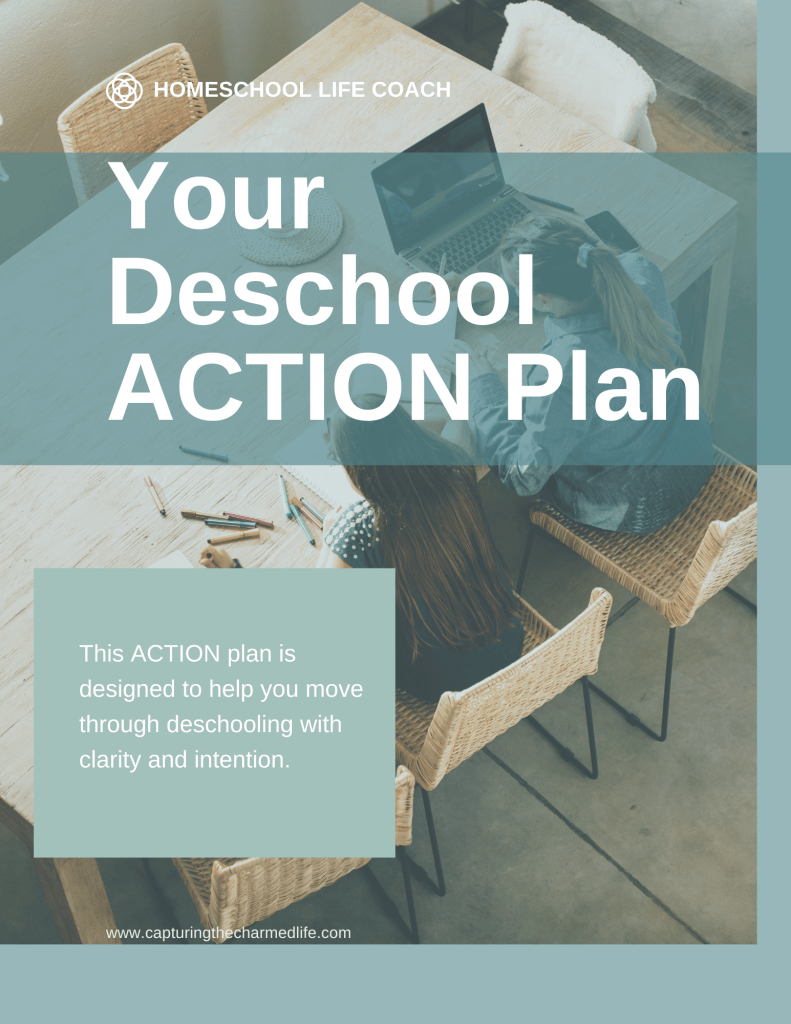
Deschool Action Plan for New (& Stuck) Homeschoolers
The Deschool ACTION Plan is a printable PDF guide to help you reset your homeschool mindset, reconnect with your child’s natural learning style, and take intentional steps toward a more confident, calm, and custom-fit homeschool.
15. But you know what else we need to do?
Sometimes the most important thing you can do to handle homeschool overwhelm is stop trying to figure it out alone.
You’ve read fifteen tips. You’ve thought about boundaries, quiet time, mindfulness, and expectations. But if you’re honest with yourself — you already knew most of this. Knowing isn’t the problem. Seeing clearly what’s actually underneath your overwhelm, and having someone help you map a path forward — that’s what changes things.
That’s exactly what the Aligned Homeschool Reset session is for. It’s a free, focused one-on-one conversation with me — Teresa — where we uncover the real roots of your homeschool overwhelm and figure out what needs to shift. Not generic advice. Not a sales pitch. Just honest support from someone who has been exactly where you are.
Book your free Aligned Homeschool Reset session →
And if you’re not quite ready for a conversation yet, start with the free quiz. It takes five minutes and shows you exactly which areas of your life are quietly draining you.

Sometimes the homeschool mom life can breed codependence & enmeshment: our children’s struggles are always their struggles, not ultimately our struggles.
Teresa Wiedrick
You Don’t Have to Figure Out How to Handle Homeschool Overwhelm Alone
If you’ve read this far, something in this post resonated with you. Maybe you recognized yourself in more than a few of these tips. Maybe you’ve been trying to push through the overwhelm for longer than you’d like to admit.
Here’s what I want you to know: the fact that you’re searching for how to handle homeschool overwhelm isn’t a sign you’re failing. It’s a sign you care — deeply — about your kids, your homeschool, and your own wellbeing. That matters.
But caring deeply isn’t enough on its own. You also need clarity.
Start with the free quiz if you’re not sure where your overwhelm is coming from. It takes five minutes and gives you personalized results across eight key areas of your life — no email required.
And when you’re ready to go deeper — when you want someone to sit with you, ask the right questions, and help you see what you can’t quite see on your own — I’d love to have that conversation with you.
The Aligned Homeschool Reset is a free one-on-one session where we uncover the real roots of your homeschool overwhelm and map out what needs to shift. No generic advice. No pressure. Just honest, focused support from someone who has been exactly where you are.
BOOK YOUR FREE ALIGNED HOMESCHOOL RESET SESSION →
Your homeschool doesn’t have to feel this hard. Let’s figure out why it does — and what to do about it.
Not ready for a conversation yet? That’s okay too. The Overcoming Homeschool Overwhelm Journaling Workbook is a self-coaching tool you can work through at your own pace — to help you identify what’s underneath your stress, address your real needs, and shift your homeschool experience from the inside out. Think of it as a first step toward clarity, in your own time and space.

Overcoming Homeschool Overwhelm Journaling Workbook
You don’t need more tips. You need clarity. This journaling workbook helps homeschool mamas dig into what’s really behind the overwhelm — unmet needs, strained relationships, and expectations that were never realistic to begin with. Work through it at your own pace and walk away knowing exactly what needs to change.
Aligned Life & Homeschool Coaching
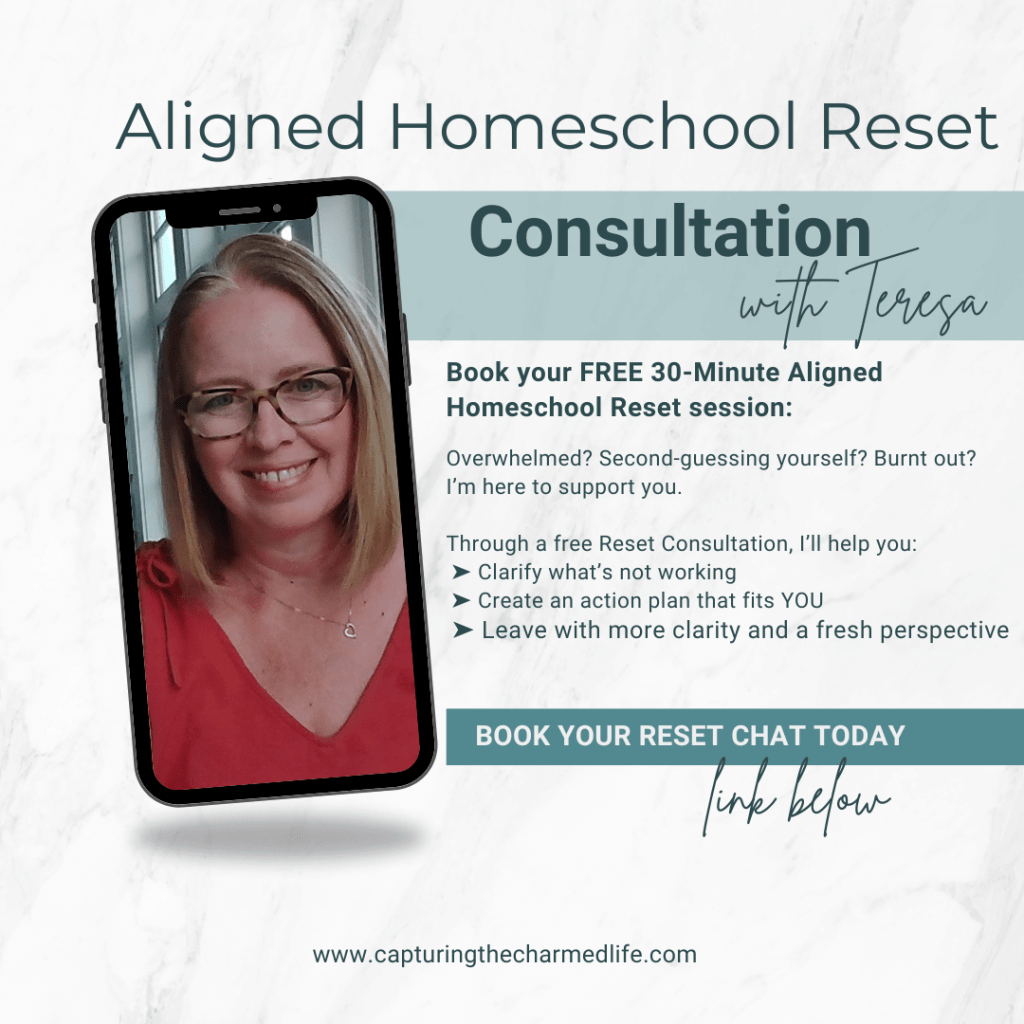
If you’re craving more than a moment of clarity — if you want transformation that becomes your new normal — the Aligned Homeschool Reset Session is your next step.
Teresa works with homeschool moms who are feeling overwhelmed, burned out, or quietly questioning if they’re enough. She’s been exactly where you are — navigating chaos, building confidence, and creating intentional, joyful homeschool lives.
In an Aligned Homeschool Reset Session, you’ll:
- Clarify your values and priorities so you can homeschool with confidence
- Explore practical strategies for leading your life and your family with intention
- Discover ways to show up fully for your kids while staying grounded and energized
If you’re ready to stop surviving and start thriving, Teresa would love to walk alongside you.
Book your Aligned Homeschool Reset Session with Teresa →
Share This Episode
Know a homeschool mom who needs to hear this? Send her this episode.
Subscribe to the Confident Homeschool Mom podcast
Call to Adventure by Kevin MacLeod
Link: https://incompetech.filmmusic.io/song/3470-call-to-adventure
License: http://creativecommons.org/licenses/by/4.0/

Well said, I enjoyed reading this post. To be a great parent we need to take great care of ourselves.